
A post that’s been sitting in my drafts folder for [looks at watch] 15 months. Dated, but worth publishing.
***
The recent suicide truck bombing in Kabul was the deadliest in a long series of attacks targeting Afghanistan’s capital and highlights an important component of the insurgency’s strategy against the Afghan regime and supporting coalition forces. Kabul was the target of an extensive urban terrorism before, during the communist era, and an examination of this earlier campaign yields insights into the strategy of the current insurgency, its assessment of the political situation within Afghanistan, and the identity of the forces who orchestrated the attack.
Throughout history, all of Afghanistan’s would-be conquerors have identified Kabul as the natural seat of power: the one city capable of exerting a degree of influence over the entirety of a country fractured by geography and ethnicity. Located at the confluence of several large valleys, Kabul is the central node for transportation and communication in eastern Afghanistan, and has been home to the few government institutions that Afghanistan managed to develop.
Naturally then, the Soviet-supported communist government of the 1980s was centered on Kabul, and it thus became a primary target for the Mujahideen resistance, orchestrated by Pakistan’s Inter-Service Intelligence and supplied by the Central Intelligence Agency. Mohammad Yousaf, the ISI general who coordinated the Afghan campaign from 1983 to 1987, described in his memoir the centrality of Kabul in the anti-communist campaign:
Kabul has great strategic importance. As we at ISI appreciated, so long as a communist government controlled Kabul it controlled the nerve centre of the country. To win the war we had not only to push the Soviets out of Afghanistan, but also to eject the Afghan communists from Kabul. Only with the Mujahideen ensconced in the capital would the world recognize our victory. Such was General Akhtar’s belief, such was our objective. In order to achieve it Kabul had to burn. (p.144-5)
It was impossible for the guerrilla Mujahideen to take Kabul by direct assault, but the ISIS assigned such importance to the city that they attempted a short-cut to victory by collapsing the city from within. There were 3 components of this strategy: (1) isolate the city from supplies and facilities by attacking lines of communication and infrastructure supporting the city; (2) bombardment of regime facilities with long-range artillery rockets; and (3) an extensive campaign of urban terrorism, which Yousaf politely described as “sabotage and assassination from within,” and illustrated with some vivid anecdotes:
These attacks could range from a knife between the shoulder blades of a Soviet soldier shopping in the bazaar to the placing of a briefcase bomb in a senior official’s office … The latter included placing a bomb under the dining-room table of Kabul university in late 1983. The explosion, in the middle of their meal, killed nine Soviets, including a woman professor. Educational institutions were considered fair game, as the staff were all communists indoctrinating their students with Marxist dogma. To the Mujahideen this was corrupting the youth of the country, turning them away from the true faith of Islam. (p. 146)
Unsurprisingly, this campaign was not enough to seriously threaten the regime’s hold on Kabul, and with Soviet assistance the security cordon around the capital was expanded and the Mujahideen were pushed further away from the city. The very idea that guerrillas could somehow conquer an enemy capital without a military victory borders on fantasy, but that apparently did not discourage the ISI. When the Soviet Union began to wind down its direct military involvement in Afghanistan, the ISI tried to revive the plan to topple the Najibullah regime, thought to be weakened by the absence of Soviet forces. This plan failed when the Mujahideen directed their energies to and ill-advised on Jalalabad in 1989, much to the chagrin of their ISI handlers, who remained fixated on Kabul:
General Akhtar had an obsession with Kabul. He was adamant that attacks on Kabul should have priority over all others. If a Commander made known to the general that he wanted heavy weapons to hit the city, then he was well on the way to getting them, even if I was opposed. Keeping the pressure on the capital was the fundamental theme of our strategy. If Kabul fell we had won the war – it was as simple as that. (p. 151)
The current terrorism campaign in 2017 has the same objective of overthrowing the capital, and though its targeting is more indiscriminate, the strategy guiding it is more sophisticated and effective. Whereas the campaign in the 1980s targeted the regime and its security services directly, the bombings in recent months are undermining the regime’s legitimacy by attacking the population’s sense of security.
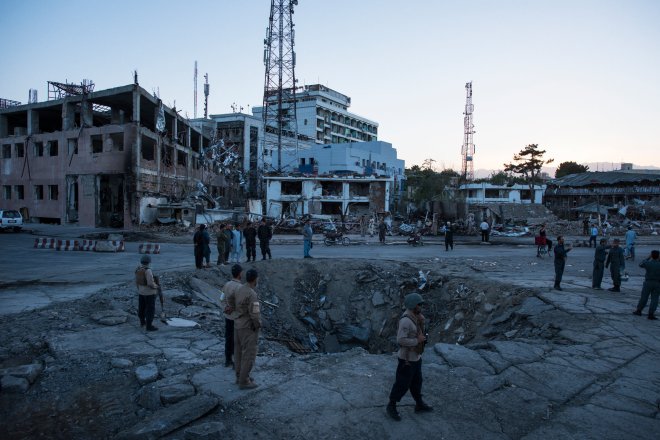
The May 31 bombing on the edge of Kabul’s Green Zone is illustrative of the strategy. A truck bomb was detonated near the German embassy during morning rush hour, killing 150 people and making it the deadliest terrorist attack in Kabul history. The objective of this attack was revealed in the days following the attack, when on 2 June violent protests at the government’s failure to provide security resulted in 5 dead at the hands of Afghan security forces. So in the eyes of the populace, not only had the government failed to protect them from terrorists, they killed them when they dared protest that fact. Days later, 3 suicide bombers struck a funeral for Salim Izadyar, a prominent victim of the protests, killing another 18 people.
The object of the entire attack cycle was revealed by a very clever tweet by Abdulqahar Balkhi, a Taliban spokesman and a wily social media operator, that appealed directly to the natural inclinations of President Trump and his political base:
#Kabul imploding, warlords about to launch turf wars, great opportunity for @realDonaldTrump to throw in towel & let savages to [sic] own devices
To recap: first, a devastating truck bomb targets civilians in morning rush hour, in an attack designed to generate the maximum body count. Days later, ethnic-nationalist rhetoric is used to gin up violent protests against the government’s failure to prevent the attack, resulting in the security forces killing additional citizens, and the funeral of one is subsequently attacked by suicide bombers. Chaos threatens to envelop the Afghan capital, and a Taliban representative invites the American President to quit the mire. A well-orchestrated series of events that strongly suggests that the tentacles of the ISI still reach deep into Afghanistan, and its old strategy of chaos and mayhem remains active.
Return address: ISI?


 Visions of Empire